
Sen. Gounardes Proposes Landmark Legislation to Regulate Screens, AI and Ed Tech in Schools
The FOCUS Act imposes age-appropriate limits on tech in classrooms, ensuring kids’ educational outcomes are prioritized over tech corporations’ profits
View the legislation here.
FOR IMMEDIATE RELEASE: AUGUST 21, 2026
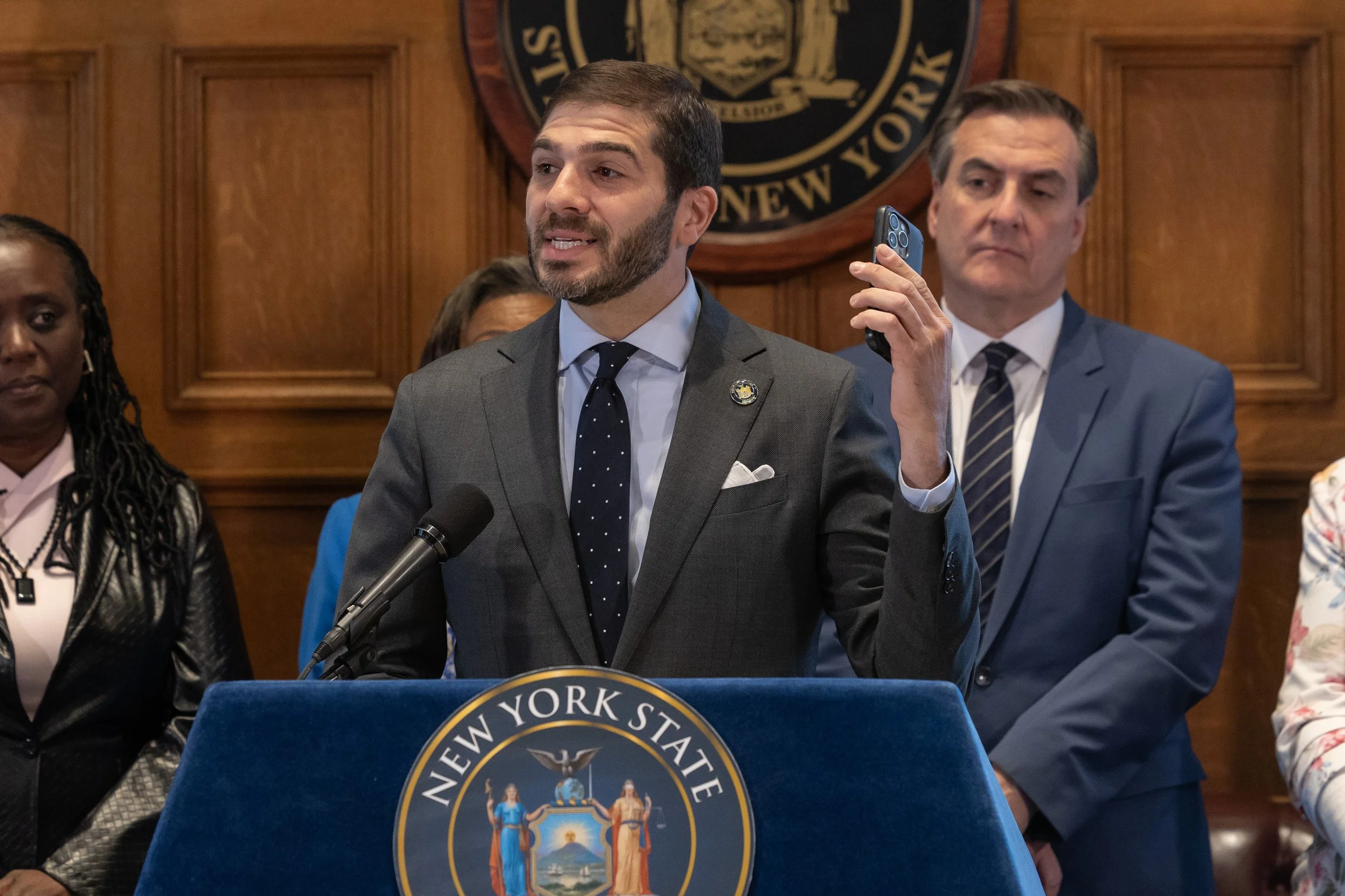
New York State Senators Andrew Gounardes, Jamaal Bailey, and Jessica Scarcella-Spanton today announced new landmark legislation that would create comprehensive, age-appropriate restrictions on technology in schools, regulating the use of screens, artificial intelligence, and other “ed tech” devices to ensure students’ educational outcomes come before the profits of tech corporations.
The Fostering Optimal Classroom Use of Screens (FOCUS) Act would create thoughtful, holistic guardrails on the use of tech in classrooms, and comes in the wake of a rapidly-growing ed tech industry selling everything from computer-based lessons and educational chatbots to AI-powered android teaching assistants.
Nearly 9 in 10 American public schools now have a “1-to-1 program” that provides every student a school-issued device like a laptop or tablet, even though evidence suggests increased classroom screen exposure is associated with weaker learning outcomes. Meanwhile, a sweeping study of 50 countries found the use of AI in education can "undermine children's foundational development" and that "the damages it has already caused are daunting."
“Tech corporations are treating kids like a science experiment, flooding schools with questionable ed tech products without oversight, family input, or basic evaluation. That free-for-all may help Big Tech’s bottom line, but it certainly isn’t helping kids learn,” said State Senator Andrew Gounardes. “My FOCUS Act fills the void by creating rules of the road to ensure learning comes first. Tech plays an indispensable role in the modern world, and we should prepare our kids to use it to lead rewarding, successful lives. But when it comes to screens in schools, we can’t afford to be on AI-powered autopilot. Smart policymaking can ensure the needs of our kids, not Big Tech’s profit motives, guide us in the right direction.”
Under the FOCUS Act, schools would generally be required to offer screen-free learning to students in grades pre-k through five, relying primarily on face-to-face and pencil-and-paper learning. Students in grades six through eight would be able access screen devices via a “computer cart” or lab model in which devices are rotated amongst students, while high school students would be able to access screens as part of a cart model or on a one-to-one basis with parent/caregiver opt in.
The bill also creates a “right to analog learning” by requiring schools to prioritize assignments that students can complete screen-free whenever feasible. Parents and students would also be able to opt out of screen usage for assignments where a reasonable, non-digital alternative exists (with exceptions for assignments where screen tech is inherent to learning objectives, such as computer science or typing classes).
The FOCUS Act also requires school-issued devices be free of social media, gaming, and direct messaging apps; chatbots, generative AI, and conversational AI platforms; and cameras—features proven to be distracting, detrimental to youth mental health, and conducive to cyberbullying while providing little educational value. And it prohibits schools from requiring students to create social media accounts to participate in official school functions.
The bill would require ed tech companies to register with the State Attorney General before offering products to school districts. In registering, companies must demonstrate their products are in compliance with laws like the Children's Online Privacy Protection Act, the Family Educational Rights and Privacy Act, and section 2-D of state education law; that they don’t include distracting features that detract from educational purposes; and that they’ve been shown in at least one independent study to result in improved academic performance. Apps that do not meet these requirements would be prohibited from being installed on school-issued devices.
The FOCUS Act would require the State Education Department to update its computer science and digital fluency learning standards (last updated in 2020), to account for recent advances in technology. That includes requiring schools to teach students about the impacts of excessive screen time on young users; the physical and mental health challenges associated with social media use; how to safely navigate direct messaging services that connect minors with unknown users; and media literacy skills.
Finally, the bill would update student privacy protections to prohibit ed tech providers from abusing student data.
“The unchecked expansion of technology in our schools has distracted our students, eroded critical thinking, and undermined the in-person connection between teachers and students,” said Senator Jamaal T. Bailey. “While technology has its place, a school-issued device should be a tool for learning, not a facilitator of distraction, cyberbullying, and cheating. As a parent, I know transparency is important for families and students which is why The Fostering Optimal Classroom Use of Screens (FOCUS) Act reframes technology in the classroom by prioritizing age-appropriate, screen-free learning, protecting student data privacy, and holding education technology providers accountable for the safety of students while in school. I am proud to sponsor this important legislation alongside Senator Gounardes and Senator Scarcella-Spanton to protect our children, support teachers, and foster distraction-free learning environments across New York State.”
“It is so important for our students to be engaged in school as they learn and discover the world. School should be a place that encourages their social and cognitive development, but too much technology can be a distraction to that,” said Senator Jessica Scarcella-Spanton. “As a mom, I personally understand these concerns and I’m proud to co- sponsor this legislation with Senators Gounardes and Bailey; the Fostering Optimal Classroom Use of Screens (FOCUS) Act will allow for the thoughtful use of technology in the classroom without abandoning traditional ways of learning. Back to the basics of encouraging our students to put pen to paper, open a book, and get away from so much screen time is what our kids deserve.”
“Big tech has made it clear that their goal is to make school classrooms a customer pipeline. The FOCUS Act will help stop these ed tech companies from preying on our students and ensure our state has clear and defined guidelines on the use of screens, AI, and technology in our classrooms,” said Council Member Shekar Krishnan, Chair of the New York City Council's Oversight and Investigations Committee. “As a parent of two young children, I’m thankful to State Senator Andrew Gounardes for taking on big tech at the state level. I’m proud to be joining him by championing the same fight for accountability in the City Council, where we will soon ask the New York City Department of Education for answers on technology use and regulations in city schools.”
“Schools should, above all, be places for children’s intellectual, social and emotional development. Technology should only be introduced into classrooms if and when it is clearly proven to help our kids learn and grow. Unfortunately, Big Tech has been relentless in their efforts to drown our schools with their products, regardless of the impact on students’ learning and well-being,” said Julie Scelfo, founder and executive director of Mothers Against Media Addiction (MAMA). “Parents across New York are demanding that our policymakers take action to roll back the out-of-control spread of edtech in our state’s schools. The FOCUS Act would put robust, thoughtful guardrails on the presence of technology, including laptops, tablets and AI chatbots, in our education system. MAMA is grateful to Senator Gounardes for his ongoing leadership in the fight to protect our kids from technology that interrupts and harms, rather than facilitates and helps their education. We are proud to support this crucial legislation.”
“The FOCUS Act would make New York State the unquestioned leader in the growing movement to reign in EdTech and protect students from AI,” said Josh Golin, Executive Director of Fairplay. “For far too long, EdTech companies have siphoned off precious education dollars by making false promises about the efficacy of their products, and now AI companies are engaged in a similar gold rush, pressuring schools to adopt their unproven and unsafe products. Research shows that students learn best from hands-on, human-led, analog education without the never-ending distractions of the internet and AI. Fairplay applauds Senator Gounardes for his leadership in taking back childhood from Big Tech and introducing this landmark legislation that puts students’ needs first.”
“For too long, school test scores have plunged while ed tech time has gone up,” said Elyssa East, special education parent, author, educator, and Distraction Free Schools New York co-lead. “Distraction Free Schools has been hearing from parents across the U.S. and New York fed up with the status quo. Kindergartners are being sent home with school-issued devices on which pornography and violent content is fully accessible. Parents are being intimidated by local school authorities for trying to opt their children out of these same devices. Kids are failing out of college and admitting they spent hours of high school class time watching movies on YouTube. Teachers are equally fed up as their jobs have pivoted to tech support or tech policing and away from actual instruction. Distraction Free Schools New York (DFS-NY) is leading a statewide coalition bringing together parents who are concerned about the harmful impacts of excessive classroom screen time, and we're proud to partner with Senator Gounardes whose passage of the SAFE for Kids Act and AI Chatbot Toy Moratorium have made him a national leader in protecting children. Drawn from our model bills, Senator Gounardes’ FOCUS bill gives New York State the opportunity to ensure that this generation of kids has safer, more developmentally appropriate education. By reining in ed tech and A.I., it will allow children to receive the kind of human-centered learning that has helped New Yorkers succeed for centuries. As a work of tech intentional legislation, this bill will maintain access to the kinds of technology that enhance learning and creativity for all, while safeguarding access for special education populations. Senator Gounardes’ FOCUS is more than a gift to this generation of children and their families, it will be an absolute life saver.”
"Over the past year, we've seen thousands of parents in New York City and across the country demand a reining in of ed tech companies. We have heard story after story of teachers being pushed aside to act as tech support in their own classrooms; of kids who have not had a teacher read their writing in over a year because all grading has been outsourced to AI; of kids coming home crying because someone named ‘Amira’ couldn't understand their accent; of books being taken out of the classroom to make more time for children to interact with chatbots. This is not the future any of us want for our kids,” said Kelly Clancy, PhD, Member of CEC District 20, founder of Parents for AI Caution in Educational Spaces, member of the AIM Coalition. “Under Senator Gounardes's leadership, the FOCUS Act restores the rights of communities, not corporations, to decide what and how kids learn. By banning AI, putting developmentally appropriate restrictions on screen use, and restoring the right to an analog education, we'll have the ability to create the kind of classrooms we want, restoring a focus on school time, not screentime."
“New York cannot tell children and families to put away their phones while requiring them to spend hours clicking through i-Ready or interacting with AI chatbots that families don’t even know their kids are engaging with. Evidence shows that children learn and develop through relationships, conversation, movement, books, art, writing, and the productive struggle of thinking for themselves. Generative AI is for surveillance, data extraction, and algorithmic shortcuts. The harm to Black, Latine, disabled, and low-income students is often produced by software that is used as a bandaid in place of the investments, fully funded schools, culturally responsive, human-centered education that they all deserve. CEC4 has passed resolutions calling for limits on screen time, an independent evaluation of EdTech, stronger privacy protections, paper-based alternatives, and family consent of use. The FOCUS Act transforms those demands into enforceable rights. Public schools must be places of human development and democracy through learning not testing grounds for predatory technology corporations and tech bros,” said Kaliris Y. Salas-Ramirez, PhD, President of Community Education Council District 4, former PEP member, neuroscientist, and East Harlem parent of two public school students.
"As a parent and school leader, I'm keenly aware of the rapidly changing landscape facing our education system," said Katie Dello Stritto, Principal at P.S. 58 The Carroll School. "Educators and parents across our state are engaged in conversations about how to prepare our students to be critical thinkers in the face of changing technology. Above all, this means offering students distraction-free spaces filled with rich discourse, ample access to texts in hand, and lots of practice with listening, speaking, and writing. Thoughtful regulations like the FOCUS Act can help us create those human-centered spaces, so we go beyond 'digital citizenship' to building real digital wellness and literacy for all children."
"Senator Gounardes' FOCUS Act establishes a fundamental right to analog learning and is a much needed protection of childhood. Reading whole books, writing essays by hand, working out calculations on paper and having synchronous conversations with caring adults are effective ways to teach children. Parents and educators, not ed tech companies, must be given the power to decide what is best for children, when it comes to the use of technology in the classroom. New statewide laws are urgently needed to outpace innovation in artificial intelligence, screens and devices used by schools. We must move fast and fix things before it is too late," said Robert Murtfeld, a public school parent and advocate.
New York has already taken important steps to regulate the presence of screens in our classrooms. Last year, the state implemented a bell-to-bell ban on personal smartphones in schools, with the goal of ending the epidemic of digital distraction and giving kids a break from social media.
That policy was based on clear research that unchecked social media usage is fueling a youth mental health crisis and making it harder for kids to focus. Initial results have been overwhelmingly positive: students are connecting with each other in person, lunch periods are loud and joyful, and nearly 90% of school staff say the policy has improved the school environment. But the ban only applies to students’ personal devices, and doesn’t address the proliferation of screens and devices issued by schools themselves. The FOCUS Act is intended to address that gap.
In recent years, Senator Gounardes has passed several pieces of legislation designed to hold tech corporations accountable and ensure digital safety, including the SAFE For Kids Act, the New York Child Data Protection Act, social media warning labels, the Stop Online Predators Act/Safe By Design Act, and the RAISE Act.
Press Contact:
Billy Richling
Communications Director
State Senator Andrew Gounardes
billy@senatorgounardes.nyc
###